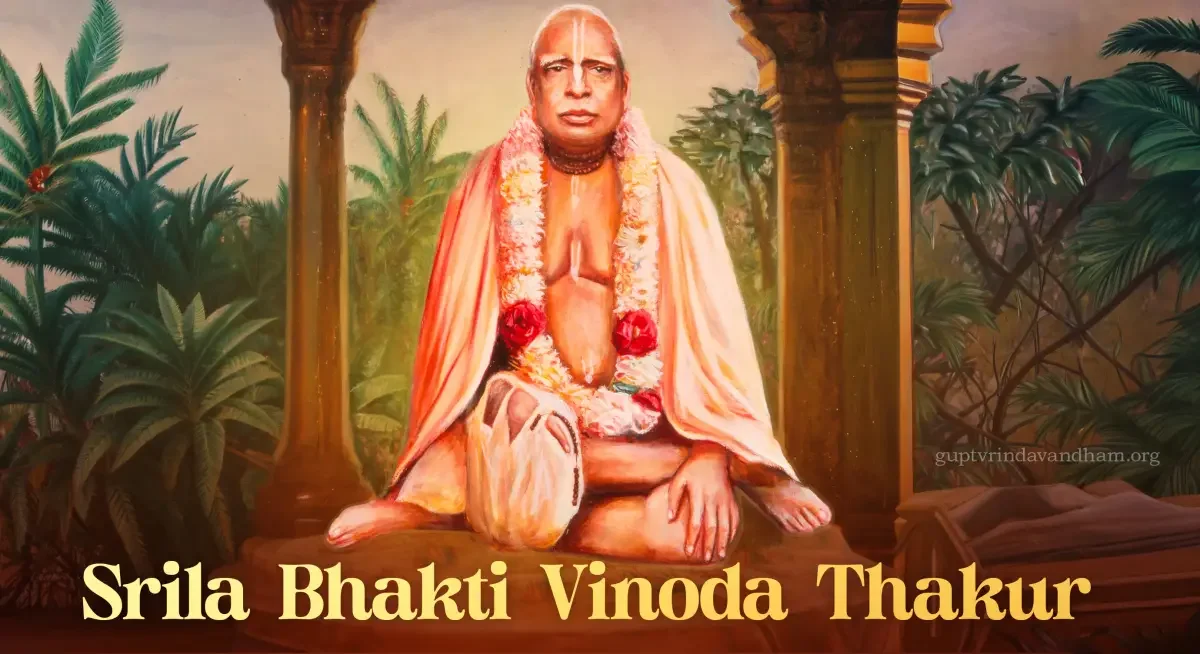
More than a hundred years ago, Srila Bhaktivinoda Thakur imagined devotees from Western countries playing mridangas and karatalas and singing the holy names in the streets of their own towns. It must have sounded far-fetched then. Today Hare Krishna temples stand on six continents, including our own community at Chaitanya Bhavan, Visakhapatnam, and his vision has come true.
He is honoured as the acharya who revived the teachings of Lord Chaitanya Mahaprabhu after centuries of decline, and the Gaudiya Vaishnava tradition calls him the Seventh Goswami. He was born Kedarnath Datta on 2 September 1838 in Ula (Birnagar), in Bengal's Nadia district, to Ananda Chandra Datta and Jagat Mohini Devi.
His Life in Brief
| Year | Event |
|---|---|
| 1838 | Born into a pious and prosperous Bengali family |
| Late 1840s | Early schooling; growing interest in Vedic scripture |
| 1849 | Father passed away when he was 11 |
| Early 1850s | Studied astrology and began to ask who the self really is |
| 1852 | Moved to Calcutta for further education |
| 1856 | Joined college at 18 |
| 1860 | Birth of his first son, Annada Prasada |
| 1861 | Lost his wife; later married Bhagavati Devi |
| 1868 | Entered government service as a Deputy Magistrate |
| 1871 | Posted to Jagannath Puri, where he lived as a model householder |
| 1874 | Birth of his fourth son, Bimala Prasada, later Srila Bhaktisiddhanta Sarasvati Thakur |
| 1880-81 | Met Jagannath Das Babaji Maharaj in Vrindavan and accepted him as his spiritual master |
| 1888 | Identified the long-forgotten birthplace of Lord Chaitanya |
| 1891 | Began the Nama-hatta movement across Bengal |
| 1894 | Retired from government service to preach full time |
| 1895 | Installed the deities of Lord Chaitanya and Vishnupriya |
| 1914 | Departed on 23 June to enter the eternal service of Radha-Krishna |
Three Episodes That Shaped His Legacy
Finding the birthplace of Lord Chaitanya
About 540 years after Lord Chaitanya appeared in Sridham Mayapur, the precise spot of His birth had been forgotten, and devotees offered competing claims. Bhaktivinoda Thakur wanted certainty, not guesses.
Tradition says he was sitting on the roof of a rest house in Navadvipa when he noticed a strange glow rising from a tall palm tree in the distance. Local people pointed him to a nearby mound covered with tulasi as the place linked to the Lord's birth. He did not simply accept what he heard. He searched the scriptures and found a passage in the Bhakti-ratnakara that matched the site exactly.
To settle the matter, he invited the very elderly Jagannath Das Babaji Maharaj, said to be over 140 years old and unable to walk without help, to visit. On reaching the place, Babaji Maharaj is said to have been overcome with joy and immediately confirmed it as the birthplace of "Nimai," the Lord's childhood name. Today the site is known as Yogapitha in Mayapur and remains a major pilgrimage centre.
A prayer answered through his own son
By the late nineteenth century, the sankirtan movement of Lord Chaitanya had strayed from its teachings. Many self-described devotees, known as prakrita-sahajiyas, were following a watered-down and distorted form of Vaishnavism. Pained by this, Bhaktivinoda Thakur prayed sincerely to Lord Chaitanya that someone would come to restore the tradition's purity.
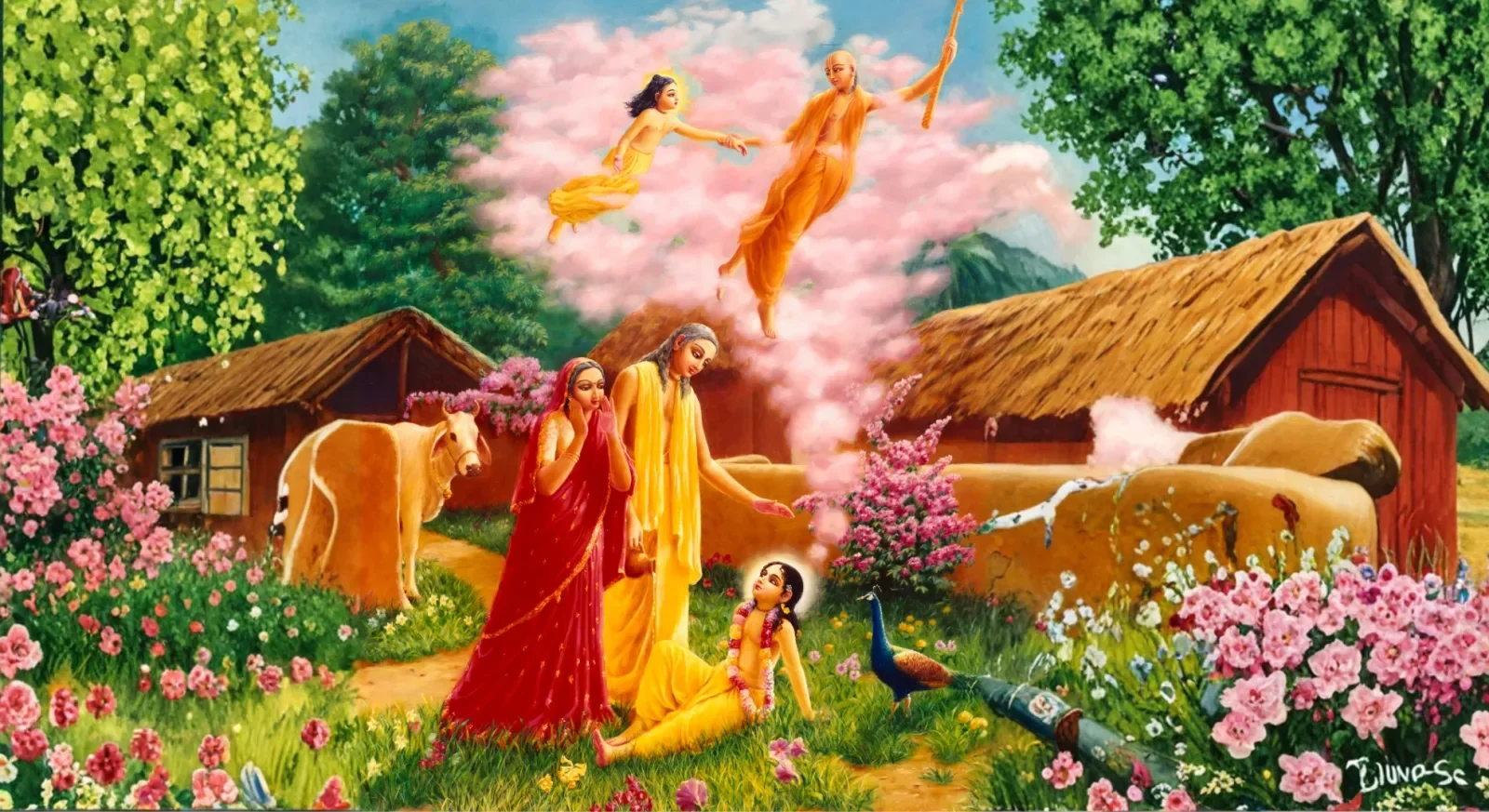
In February 1874 his fourth son, Bimala Prasada, was born, the future Srila Bhaktisiddhanta Sarasvati Thakur. One incident from the child's infancy is remembered. During the Ratha Yatra in Jagannath Puri, Lord Jagannath's chariot stopped directly in front of their house. The boy's mother placed the six-month-old child near the chariot, and a garland is said to have fallen onto him. Bhaktivinoda Thakur took it as a sign that his prayer had been heard.
Confronting a false guru
As Deputy Magistrate of Puri, Bhaktivinoda Thakur also had, by local custom, a role in matters concerning the Jagannath Temple. During his time there, a man calling himself an incarnation of Vishnu gathered followers in a nearby village. His conduct was unfit for any real spiritual teacher, and he openly derided the Jagannath Deity as "mere wood."
Seeing a fraud who was exploiting people's faith, Bhaktivinoda Thakur went there personally, without ceremony, and had him arrested. Accounts say the man was believed to wield some mystic power, and members of Bhaktivinoda's household reportedly fell ill with fever soon afterward. Even so, he stood firm that the impostor must answer for his actions, holding that justice mattered more than personal risk. The man was sentenced and, as the story goes, did not survive his imprisonment. What the episode shows is not drama but resolve: he would not let offence against the Lord pass unchallenged, whatever it cost him.
How He Spent His Day
Though his government job was demanding, Bhaktivinoda Thakur arranged almost every hour around service. His routine ran roughly as follows:
- 8-10 PM: Rest
- 10 PM-4 AM: Writing books and other literary work
- 4-4:30 AM: Short rest
- 4:30-7 AM: Chanting japa
- 7-7:30 AM: Letters and correspondence
- 7:30-9:30 AM: Scriptural study
- 9:30-10 AM: Bath and a light meal
- 10 AM-1 PM: Court work, often dozens of cases in a day
- 1-2 PM: Return home
- 2-5 PM: More court duties
- 5-7 PM: Translating Sanskrit works into Bengali
- 7-8 PM: Bath and evening meal
This steady blend of duty and devotion is why he is held up as a model for householders. A demanding career and a serious spiritual life can go together.
Srila Prabhupada's Appreciation
Srila Prabhupada often credited Bhaktivinoda Thakur with reviving Krishna consciousness when its original teachings had nearly vanished, and called him a nitya-siddha, an eternally liberated soul who came to guide people of this age. Bhaktivinoda Thakur had himself foreseen that someone would carry Lord Chaitanya's message across the world. Srila Prabhupada fulfilled that, travelling around the globe more than a dozen times, though he gave the credit entirely to his predecessors.
Prabhupada also pointed to Bhaktivinoda Thakur as the ideal householder devotee, one who met his family and professional duties in full without ever neglecting devotion, and who raised a son, Bhaktisiddhanta Sarasvati Thakur, who became one of the great gurus of Gaudiya Vaishnavism.
His Eternal Identity
In the fifth chapter of his Gitamala, Bhaktivinoda Thakur describes his own eternal spiritual form as Kamala Manjari, an ever-youthful maidservant who lives in Svananda-sukhada-kunja and serves alongside Lalita Sakhi, preparing camphor and other offerings in the service of Srimati Radharani.
What He Gave to the Tradition
- A large body of writing. He wrote close to a hundred books in Bengali, Odia and English on philosophy, scriptural commentary and practical devotional guidance. Jaiva Dharma, Saranagati and Sri Harinama Chintamani are still core reading.
- Mayapur and the Nama-hatta. Besides identifying Lord Chaitanya's birthplace, he built up the Nama-hatta: informal community gatherings for chanting together and discussing Krishna consciousness, which carried the movement beyond temple walls.
- Songs of devotion. He composed hundreds of songs and prayers, many still sung in temples, including Gaura Aarti, Jaya Radha Madhava and Ohe Vaishnava Thakur. Srila Prabhupada often said that merely singing them, even without grasping every meaning, can soften the hardest heart.
Places Linked to His Life
- Birnagar (Ula), Nadia: his birthplace and early schooling
- Calcutta: higher studies and later life as a householder
- Jagannath Puri, Odisha: where he served as Deputy Magistrate, oversaw temple affairs, and where Bhaktisiddhanta Sarasvati was born
- Vrindavan: where he accepted Jagannath Das Babaji Maharaj as his guru
- Mayapur (Yogapitha): the site he rediscovered as Lord Chaitanya's birthplace
- Godrumadvipa, Surabhi Kunja: where he built a bhajan kutir and held Nama-hatta gatherings
- Svananda Sukhada Kunja, Godrumadvipa: his home in retirement, where much of his later writing was completed
Quick Answers
Who was he?
A Gaudiya Vaishnava acharya who revived the teachings of Lord Chaitanya Mahaprabhu after they had faded following the passing of the original six Goswamis.
Where and when was he born?
In Ula (Birnagar), Nadia district, West Bengal, in 1838, as Kedarnath Datta.
What is his eternal spiritual identity?
In his own writings he names himself Kamala Manjari, a maidservant of Srimati Radharani in the spiritual world.
Whom did he marry?
Bhagavati Devi, after the passing of his first wife.
Who wrote the Gaura Aarti?
Srila Bhaktivinoda Thakur, among his many devotional compositions.
Which of his children is best known?
His fourth son, Bimala Prasada, who became Srila Bhaktisiddhanta Sarasvati Thakur.
Closing Reflection
From recovering a lost sacred birthplace to composing hundreds of songs, Bhaktivinoda Thakur showed that devotion to Krishna does not mean walking away from responsibility. It means offering every part of life as service. His example helps devotees, including our community at HKM Visakhapatnam, balance everyday duties with steady spiritual practice.
To learn more about the acharyas of our lineage, visit us at Chaitanya Bhavan, Visakhapatnam, or read our other posts on Krishna consciousness and Gaudiya Vaishnava history.