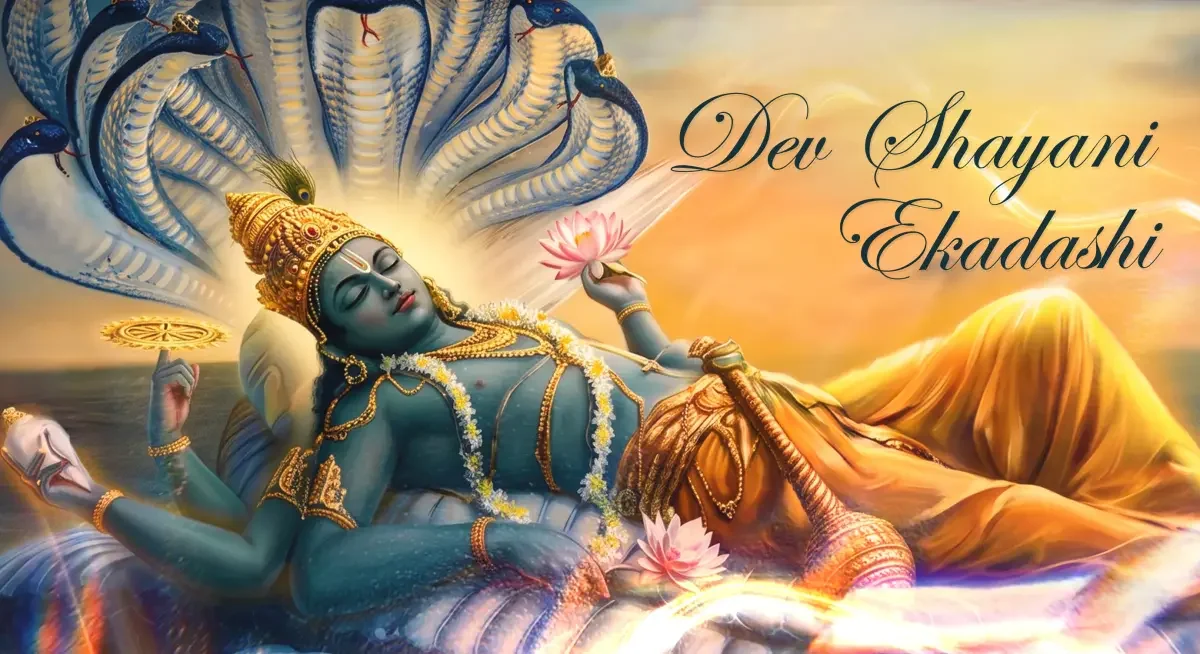
Why do the scriptures say that Lord Vishnu goes to rest for four months, and what are we meant to do while He does? That question is at the heart of Devshayani Ekadashi, also called Shayani Ekadashi, which falls on 25 July 2026.
It is a milestone on the Vaishnava calendar. The day always falls on the eleventh lunar day of the waxing moon (Shukla Paksha) in the month of Ashadha, between June and July. From here on, devotees turn toward more hearing, chanting and service, and the Lord's "sleep" becomes an invitation to slow down.
The name and its many forms
The name explains itself: dev is the Lord and shayani means resting. It is the day on which the Lord of the universe enters Yoga Nidra, while remaining present as the Paramatma in the heart of every living being.
The same day is known as Ashadhi Ekadashi, Hari Shayani Ekadashi, Padma Ekadashi, Maha Ekadashi, Devpodhi Ekadashi and Vishnu Shayani Ekadashi. In South India it is called Tholi Ekadashi, because it is the first Ekadashi of the sacred season. It comes after the Rath Yatra of Lord Jagannath in Puri. Devotees fast, and use the day as a reminder to pause and reconnect with the Lord.
The story told to Yudhishthira
The Bhavishyottara Purana and the Padma Purana record that Lord Krishna Himself explained this Ekadashi to King Yudhishthira. Lord Brahma had originally taught it to the sage Narada.
Yudhishthira asked what the Ekadashi of the bright fortnight of Ashadha was, and how to keep it so as to please Lord Vishnu. Krishna replied that Devshayani Ekadashi is among the best days of Kali Yuga, and that it grants liberation to all beings. He then told this history.
King Mandhata and the drought
Mandhata, of the Ikshvaku dynasty, was a truthful, self-controlled and compassionate emperor. For years his land had enjoyed good fortune, until a terrible calamity struck and the people went hungry. No yajnas were being performed, and the subjects, suffering daily, came to the king to say that the shortage of food was caused by the absence of rain. They begged him to act, saying that if the famine continued they would have to seek refuge in neighbouring realms.
The king agreed that the situation was grave and promised that he was working on a solution. When the citizens left, he worshipped Lord Vishnu and went out with a small party, visiting the retreats of many sages until he reached the ashram of Rishi Angira, a mind-born son of Lord Brahma.
The rishi had finished his rituals. He welcomed the king, blessed him and asked why he had come. Mandhata described the famine and said that although he had always ruled righteously, his people were suffering. He asked for a remedy.
Angira replied gently that the age was one in which dharma stood complete on all four pillars: truthfulness, compassion, austerity and cleanliness. In this age penance was reserved for brahmanas, but a shudra was practising it in the kingdom. That reversal of roles, he said, was why the rain had stopped, and the king would have to put the shudra to death.
Mandhata refused. He could not kill an innocent man who was performing austerities, and asked for another way. Angira then told him to keep the fast of Devshayani Ekadashi, in the bright half of Ashadha, according to the proper rules.
The king returned home and observed the vrat as instructed. The rains returned, and the famine ended.
Devshayani Ekadashi and Chaturmas
This Ekadashi opens Chaturmas, the four sacred months of the rainy season. According to tradition, the Lord retires to the cosmic ocean, Ksheer Sagar, to rest. During this time ceremonies such as weddings and housewarmings are traditionally put on hold until Dev Uthani Ekadashi.
The Lord's sleep is not ordinary sleep. It is Yoga Nidra, a symbol of renewal that tells devotees to look inward and intensify their practice during the monsoon. In older times, sages would stay in one place through these months so as not to harm the many small creatures that appear with the rains, and used the time for study and realisation.
Other traditions connected to the day
- A popular belief holds that during these four months the Lord stays in Sutala at the door of King Bali, a memory of His Vamana avatar.
- In Maharashtra, thousands of pilgrims walk barefoot in the Pandharpur Wari to the temple of Lord Vitthal, a beloved form of Vishnu.
- Some scriptures link the day to the demon Shankhasura, whom Vishnu defeated to protect the Vedas, after which He is said to have begun His long rest.
Giving on Devshayani Ekadashi
Charity is a chance to cleanse one's karma and to serve others. According to the scriptures, giving grains, water and clothes on this day is especially auspicious, and acts of compassion on Ekadashi are said to bring benefit for life.
Whatever you can offer, small or large, will be valued if given with sincerity. Serving the Lord's devotees, by sharing prasadam or supporting kirtan, is one of the simplest ways to please Him.