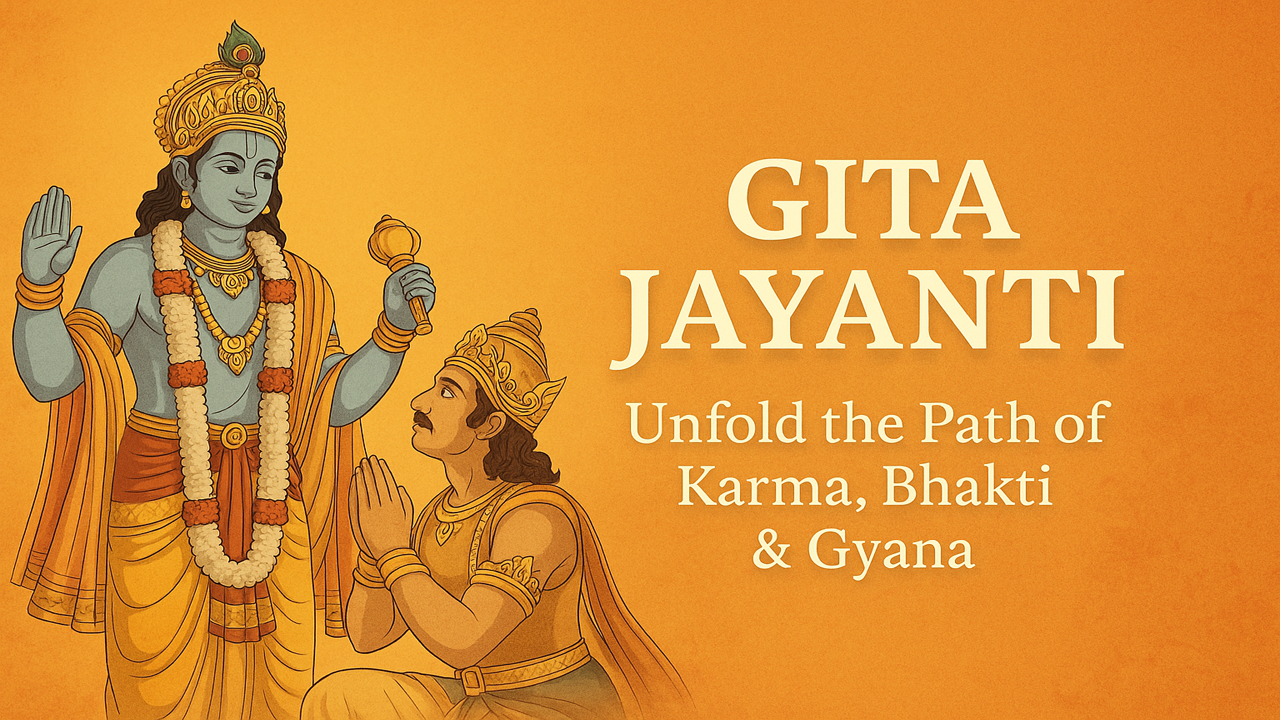
Gita Jayanti marks the day when Lord Krishna spoke the Bhagavad-gita to His friend and devotee Arjuna on the field of Kurukshetra. Arjuna, torn by grief and unable to decide where his duty lay, turned to Krishna for help. What he received was far more than a pep talk: it was a full spiritual science covering the nature of the self, the purpose of human life, action and its consequences, yoga, devotion and surrender.
The day is traditionally observed on Mokshada Ekadashi, in the bright fortnight of Margashirsha. In 2026 it falls on 20 December. It is the birthday, in a sense, of divine knowledge entering the world, not merely the anniversary of a book.
What makes the Gita special
Bhagavad-gita means "the song of the Lord." Its seven hundred verses were spoken by Krishna Himself, and they set out a clear path to self-realization and loving service. The Gita does not tell us to walk away from our responsibilities; it shows how to carry them out with a purified outlook. Work done without selfish attachment and offered to Krishna becomes yoga:
"Whatever you do, whatever you eat, whatever you offer or give away, and whatever austerities you perform, do that, O son of Kunti, as an offering to Me." (Bhagavad-gita 9.27)
Our jobs, family duties, talents and belongings can all be sanctified in this way.
First lesson: you are not the body
Much of our worry comes from identifying completely with a body that is always changing. The Gita opens its teaching by explaining the eternal soul. The body moves from childhood to youth to old age while the conscious self stays the same, and at death the soul takes another body. This knowledge does not make us cold or careless. It brings steadiness, patience and a deeper sense of duty, and since every living being is an eternal soul, compassion grows naturally.
Learning the Gita through parampara
Krishna explains that this knowledge comes down through disciplic succession, parampara. If that chain is broken, the original meaning gets blurred. Arjuna grasped the Gita because he accepted Krishna as the Supreme Lord and listened with humility. We can follow his example by studying Bhagavad-gita As It Is under the guidance of guru, sadhu and scripture, rather than separating Krishna from His own words. The Gita is not a collection of motivational quotes but Krishna's personal invitation to revive a relationship we have forgotten.
The central message
Across eighteen chapters Krishna discusses action, knowledge, meditation, the three modes of nature, His universal form and much else. All of it leads to one personal instruction:
"Abandon all varieties of religion and just surrender unto Me. I shall deliver you from all sinful reactions. Do not fear." (Bhagavad-gita 18.66)
Surrender is not passivity. It means accepting Krishna as protector, well-wisher and final shelter, and arranging life so that remembering and serving Him comes easily. Arjuna did not leave the battlefield after hearing the Gita; his doubt dissolved and he acted on Krishna's word. The real fruit of studying the Gita is likewise clarity, devotion and determined action.
Why it still speaks to us
We have more speed, comfort and information than any earlier age, yet stress, loneliness, fear and a sense of purposelessness remain common. The Gita goes to the root. It teaches that:
- we are eternal souls, not temporary bodies;
- external possessions alone cannot make us happy;
- every action has consequences;
- the restless mind can be disciplined by spiritual practice;
- Krishna is the owner, controller and friend of all beings;
- lasting peace comes from restoring our relationship with Him; and
- the highest perfection is loving devotional service to Krishna.
It does not promise a life free of difficulty, but it shows how to meet difficulty with spiritual intelligence and reliance on Krishna.
Ways to observe Gita Jayanti
- Read the Gita. Even one verse with its explanation each day is better than occasional hurried reading.
- Listen to discourses. Go to a temple program or hear devotees who present the Gita faithfully through the disciplic line.
- Recite the verses. Many temples recite all eighteen chapters on this day, and families can read selected chapters together at home.
- Chant the maha-mantra. A purified heart understands the Gita better:
Hare Krishna Hare Krishna, Krishna Krishna Hare Hare
Hare Rama Hare Rama, Rama Rama Hare Hare - Offer your food and work. Cook pure vegetarian food, offer it to Krishna and take it as prasadam, and try to do your daily tasks as service, in the spirit of Bg. 9.27.
- Give the Gita. Distributing copies is a valuable service, giving someone the chance to learn about the soul and begin to remember Krishna.
Let it enter daily life
The best offering on this day is to actually follow Krishna's instructions. Start small: a verse each day, a few minutes of attentive chanting, offering your meals, or remembering Krishna while you work. Modest but sincere habits slowly change the heart. May Gita Jayanti carry us from confusion to clarity and from fear to faith at the feet of Lord Krishna.
Hare Krishna!