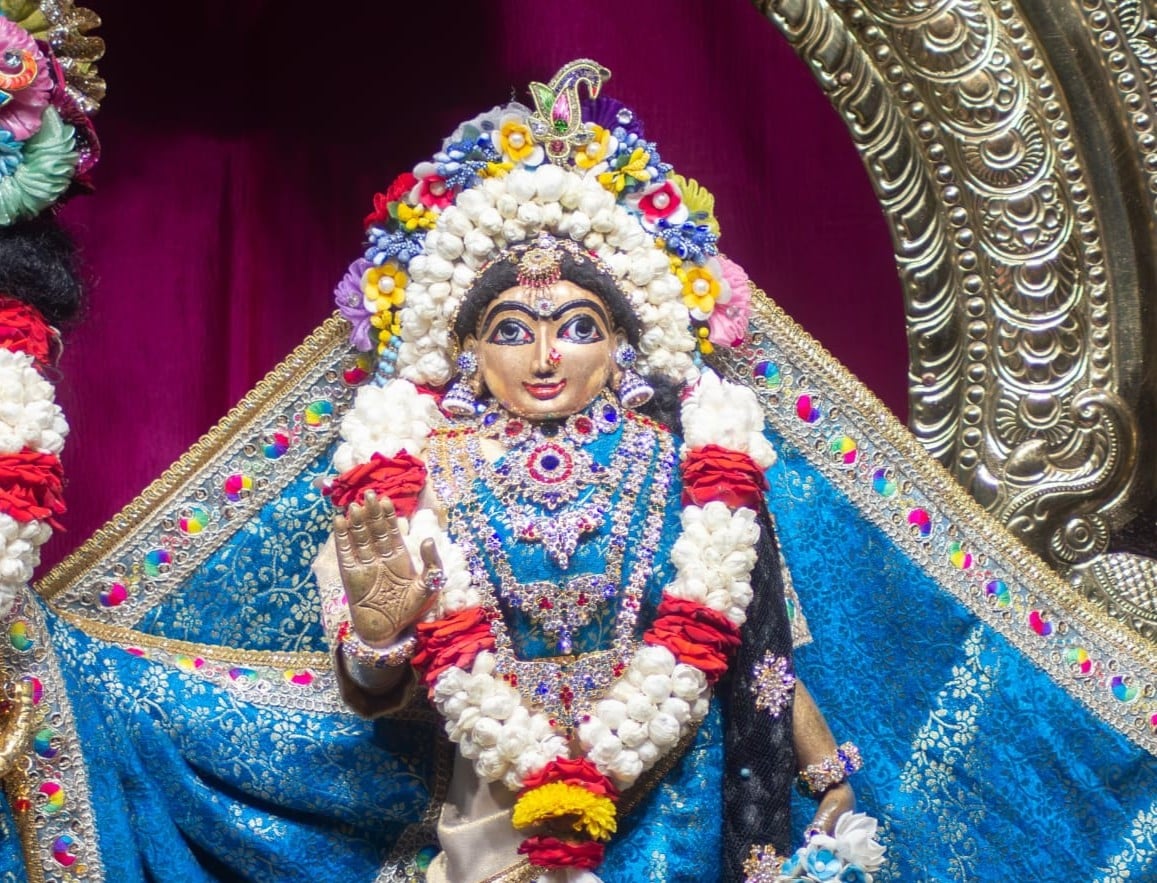
Two weeks after Janmashtami, the Vaishnava calendar arrives at a gentler festival: the appearance day of Srimati Radharani. In Gaudiya Vaishnava theology She is Krishna's eternal consort and the embodiment of devotional love itself.
Who Radharani is
If Krishna is the source of all incarnations, Radharani is the personification of His internal pleasure potency. Her love for Him is regarded as the ideal of devotion, free of any wish for personal gain. Srila Prabhupada often said that to approach Krishna, one must first approach Radharani, because it is by Her mercy that a devotee's service becomes sweet and not merely dutiful.
By tradition She appeared in Barsana, near Vrindavan. Her name, Radha, is said to come from a Sanskrit root meaning "worship" or "the one worshipped", reflecting Her special place among the gopis of Vraja.
How the temple observes it
Devotees fast until noon. The Deities are then given an elaborate abhishekam, a ceremonial bath with milk, yogurt, honey, ghee and rosewater, with continuous chanting of Radharani's names. Afterwards the Deities are dressed in Her favourite colours, often pink and gold, and the day ends with kirtan and a feast offered first to Her.
The mood differs from the lively midnight celebration of Janmashtami. Radhashtami is softer and more personal, and many devotees spend the day reading about Her qualities and selfless love, which makes it as much a time for quiet reflection as for festivity.
A day to practise humility
Since Radharani stands for the perfection of selfless service, devotees use this day to renew their own commitment to seva, not for recognition or results but because service is itself the highest joy. At Hare Krishna Vaikuntham, many choose Radhashtami to begin a new commitment: a daily chanting vow, a weekly hour of temple service or a promise to visit more regularly.
You are welcome to join us for the abhishekam and evening kirtan. Radhashtami is one of the more contemplative festivals on our calendar and a lovely way in for anyone curious about the devotional heart of this tradition.