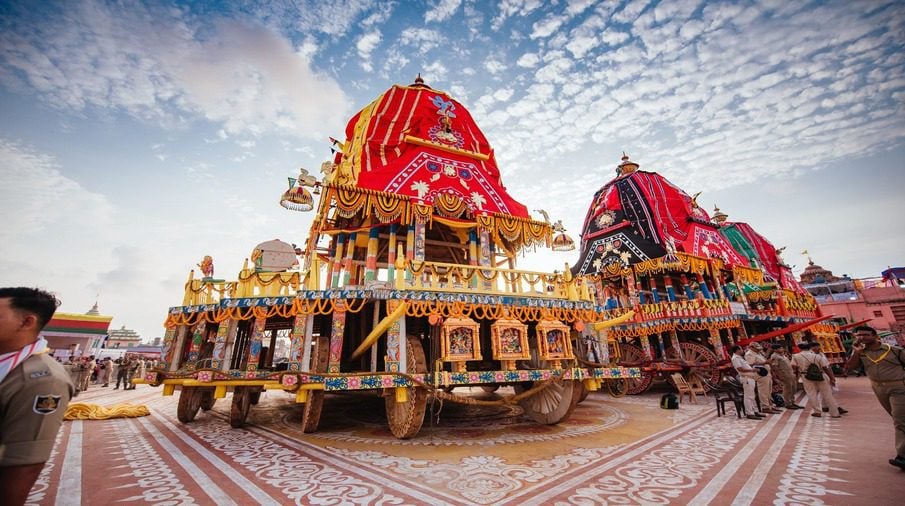
Once a year, roads usually full of traffic fill instead with color, music and devotion. Huge wooden chariots carrying Lord Jagannath, Baladeva and Subhadra Devi are drawn forward by the hands of thousands of devotees, not by machines. This is Ratha Yatra, the Festival of Chariots, one of the oldest festivals still celebrated continuously, and one of the happiest days in the calendar of the Hare Krishna movement.
Beginnings at Jagannath Puri
The festival goes back thousands of years to the coastal town of Jagannath Puri in Odisha, home of the ancient deity Lord Jagannath, a form of Krishna Himself. Tradition holds that His distinctive form, with its large round eyes, expresses the intense separation Krishna felt from the people of Vrindavan after He left for Mathura, leaving behind the cowherd community among whom He had grown up.
Every year the deities of Jagannath, His brother Baladeva and His sister Subhadra are brought out of the main temple, placed on tall, richly decorated chariots and pulled in procession to the Gundicha Temple. They stay there for several days before returning.
Lord Chaitanya and the festival
Ratha Yatra had been celebrated in Puri for centuries, but about five hundred years ago Sri Chaitanya Mahaprabhu made it a festival of overflowing devotion. The Chaitanya-charitamrita describes Him leading kirtan and dancing before the chariots with such feeling that those watching were moved to tears. He is also remembered for cleaning the Gundicha Temple with His own hands before the deities arrived, an act of humility that devotees recall each year in the Gundicha-marjana ritual of temple cleansing held before the festival.
Srila Prabhupada takes it to the world
Srila Prabhupada loved Ratha Yatra from childhood. It is said that as a boy of about five in Kolkata he built a small cart of his own and pulled it around the neighborhood with his friends, long before he founded ISKCON. Decades later he brought the festival to the West, beginning in San Francisco in 1967, the first time Lord Jagannath's chariot procession was held outside India.
Today it is among the most visible public events of the Hare Krishna movement, with annual processions in major cities on nearly every continent, from Toronto and Montreal to London and Sydney. Each is open to everyone, whatever their background or beliefs.
What you will see
- The procession: devotees, often thousands, take turns on the ropes of the chariots, which is regarded as a very auspicious act of service.
- Non-stop kirtan: chanting and dancing accompany the chariots the whole way, with mridangas and karatalas.
- Prasadam: sanctified vegetarian food is offered freely along the route and at the festival grounds.
- Cultural programs: many festivals include stage performances, talks on philosophy and community stalls after the chariots arrive.
Why devotees value it
Traditional teachings say that merely seeing the Lord on His chariot is spiritually beneficial, and devotees regard it as a step toward freedom from repeated birth and death. For this reason Ratha Yatra is treated as a real opportunity for spiritual progress for anyone who joins in, helps or even just watches the chariots go by.
Common questions
What is Ratha Yatra?
An annual procession in which the deities of Lord Jagannath, Baladeva and Subhadra are taken through the streets on large decorated chariots.
Where did it begin?
At Jagannath Puri in Odisha, where it has been observed for thousands of years.
Who brought it outside India?
Srila Prabhupada, founder of ISKCON, held the first celebration outside India in San Francisco in 1967.
What does Lord Jagannath's form signify?
He is understood to be Krishna in the mood of deep separation and longing for His childhood companions in Vrindavan.
Can anyone take part?
Yes. The celebrations are open to the public, usually with free prasadam and cultural programs for all.
To sum up
Ratha Yatra is both ancient and strikingly modern, rooted in centuries of tradition yet still drawing newcomers in cities everywhere. Whether you pull a rope, join the kirtan or watch from the roadside, you share in a celebration that Srila Prabhupada devoted his life to offering the world.
To hear about upcoming festivals and celebrations at HKM Visakhapatnam, stay connected with us at Chaitanya Bhavan, Gambhiram.